Sundown Towns by James W. Loewen
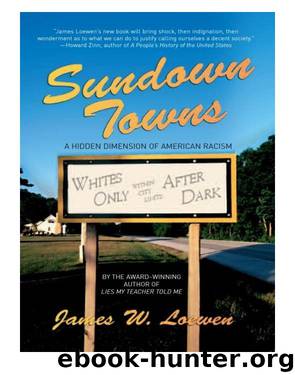
Author:James W. Loewen
Language: eng
Format: epub
Publisher: The New Press
Published: 2011-10-12T04:00:00+00:00
Other Survival Tactics
Some African Americans managed to survive without a protector. Sometimes maintaining a low profile worked as a survival stratagem for African Americans who lived independently. After the 1908 race riot in Springfield, Illinois, when small towns all around Springfield were expelling their African Americans, residents of Pleasant Plains made an exception, ordering all blacks out, except for one elderly couple who were “old and law abiding.” When Ambrose Roan, probably the only African American man in Porter County, Indiana, died in 1911 at the age of 66, the Chesterton Tribune called him “a hard working, peaceful man, of quiet, unassuming ways.” The tiny town of Hazel Dell, Illinois, a few miles south of Greenup, had an African American blacksmith. According to a Greenup resident. “He simply disappeared at sundown and you never saw him again until morning.” The fact that his occupation was simultaneously useful and archaic, thus not a threat to most whites, probably helped ensure his safety.21
Living in such nonresidential places as above a downtown business worked for some African American individuals, although not for families. Huntington, Indiana, would never let African Americans live independently in a neighborhood, but it allowed an elderly African American man to live downtown, in an otherwise abandoned upstairs room above a store. He was called “Rags” and made a living by washing windows in the downtown area. “He, too, was tolerated but watched,” according to an elderly Huntington native.22
Overt identification with the white community was another survival tactic. Such blacks became “Tonto figures”—taking pains to associate with the “white side,” differentiated from the hordes of blacks outside of the city limits. White workers in Austin, Minnesota, repeatedly expelled African Americans, and Austin became a sundown town, but like many others, it allowed one African American to stay—the shoeshine “boy.” Union member John Winkols tells about him:And I’ll tell you a good one: so one time we had Frank—I forget his last name—he was shining shoes in the barbershop and then afterwards he bell-hopped for the bus in town here, and everybody liked him. . . . He’d never go in the packing house because he knew he couldn’t, he didn’t want to go there.
So one day I was walking along . . . and here came a couple of niggers, and they stood there by the bridge facing the packing house, and . . . [Frank] says, “Y’know, John,” he says, “when the damn niggers start comin’ into this town, I’m gonna get the hell outta here.” And he was black! He was black! He didn’t want them to come into town either.... But we never had no trouble with Frank at all.
Download
This site does not store any files on its server. We only index and link to content provided by other sites. Please contact the content providers to delete copyright contents if any and email us, we'll remove relevant links or contents immediately.
| Africa | Americas |
| Arctic & Antarctica | Asia |
| Australia & Oceania | Europe |
| Middle East | Russia |
| United States | World |
| Ancient Civilizations | Military |
| Historical Study & Educational Resources |
Cat's cradle by Kurt Vonnegut(15355)
Pimp by Iceberg Slim(14508)
4 3 2 1: A Novel by Paul Auster(12392)
Underground: A Human History of the Worlds Beneath Our Feet by Will Hunt(12098)
The Radium Girls by Kate Moore(12028)
Wiseguy by Nicholas Pileggi(5786)
The Fire Next Time by James Baldwin(5446)
Perfect Rhythm by Jae(5403)
American History Stories, Volume III (Yesterday's Classics) by Pratt Mara L(5308)
Paper Towns by Green John(5191)
Pale Blue Dot by Carl Sagan(5008)
A Higher Loyalty: Truth, Lies, and Leadership by James Comey(4964)
The Mayflower and the Pilgrims' New World by Nathaniel Philbrick(4504)
The Doomsday Machine by Daniel Ellsberg(4490)
Killers of the Flower Moon: The Osage Murders and the Birth of the FBI by David Grann(4447)
The Sympathizer by Viet Thanh Nguyen(4390)
Too Much and Not the Mood by Durga Chew-Bose(4348)
The Borden Murders by Sarah Miller(4325)
Sticky Fingers by Joe Hagan(4199)
